Satellite Pictures | Meetings | Forecast Products | Contact Us
Forecasting Services
Mr. M.R.Matitu  - Ag. Director of Forecasting
Mr. M.R.Matitu -Ag. Director of Forecasting

The forecasting division comprises of five major sections, namely:-

  1. Central Forecast office (CFO)
  2. Marine Meteorological Services
  3. Aeronautical Meteorology Services
  4. Public Weather Services(PWS)
  5. Modeling and Verification Services


The five sections are interdependent with the bulk of the functions being of operational nature. In a nutshell the division deals with, collection and exchange of weather data both internally and externally; weather analysis, issuing and disseminating forecasts and other weather information such as warnings etc. to targeted users and the general public. A brief summary of activities undertaken by various sections is given under separate headings.

The section performs the following functions:

Weather Forecasting

The CFO issues weather forecasts that include daily 24 hours forecasts and tailored forecasts for public weather services, aviation, warnings of hazardous weather and climate conditions such as tropical cyclones, droughts and floods.

Ten day (Dekadal) bulletins, monthly, seasonal weather outlooks and advisories are also issued routinely.

The section also prepares meteorological products and impact assessments in collaboration with other sections i.e. Agro meteorology, Environment and Research and Hydrology for the purpose of distribution to customers and users.

Data collection and exchange

The CFO through its national telecommunication centre collects and exchanges observational data at national, regional and international level by using the Global Telecommunication System (GTS) and the Aeronautical Fixed Telecommunication Network (AFTN). The Centre is equiped with the African Meteorological Environmental diagnostic Intergrated System (AMEDIS), which is intergrated with the Satellite Distribution System (SADIS) and the Meteorological Data Distribution (MDD).

The AMEDIS links CFO with Zanzibar, Kilimanjaro and Mwanza zonal offices and the GTS Regional Telecommunication Hub (RTH) Nairobi. At present the speed between Dar es Salaam and Nairobi, Dar es Salaam and Kilimanjaro is 9.6 kilo bytes per second (kbps), Dar es Salaam and Zanzibar 28.8 kbps while it is 75 bd for Dar es Salaam to Mwanza.

Ground Satellite Receiving Station

The CFO has a Primary Data user Station (PDUS) for reception of cloud imagery information. There is also a Meteorological Data Distribution System (MDD) which is used to receive from satellite, data and Numerical Weather Prediction (NWP) products from other world centres such as the Meteorological Office - UK, Toulouse - France and the European centre for Medium Range Weather Forecasts (ECMWF) Reading - UK.

The Satellite Distribution System (SADIS) also receives meteorological products for aviation.

Upper Air observations

There are three Upper Air stations, namely Dar es Salaam, Kigoma, and Mtwara All the three stations are currently not operational for various reasons. There are also no Pilot Balloon Ascents done due to defective Hydrogen generating pots and lack of consumables. Plans are underway to revive the two upper air stations (Kigoma and Mtwara) and pilot balloon stations. A WMO/VCP request is also being sought for the Dar es Salaam upper air station.

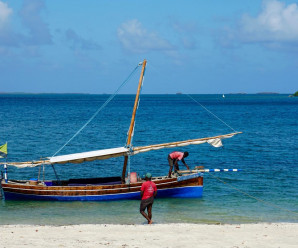
The primary role of this section is to provide meteorological services to improve safety, efficiency and regularity of marine operations. The service is supposed to cover fishing, passenger, cargo, oil and gas exploration and recreational marine operations.

The marine Meteorological Section when fully operational, will have five port meteorological offices, namely, Dar es Salaam, Zanzibar, Tanga and Mtwara on the Indian Ocean and Mwanza on Lake Victoria.

Operational Marine Meteorological Services is a relative new discipline in Tanzania because for a very long time, there has been limited contact between vessel operators and meteorological personnel. Efforts are therefore underway to establish a working relationship between the two.

Currently, TMA's daily weather forecasts which are broadcast through radio, Television and the press include a forecast of coastal winds and the state sea. Warnings of hazardous' weather e.g. tropical cyclones are normally given as appropriate through the above mentioned media.

The section provides meteorological services for national and international air navigation for the safety, regulation and efficiency of air travel. It also provides support during SAR operations by providing vital meteorological information during a search in both, marine and aviation accidents.

Currently, the Agency provides Services at 5 airports and 9 aerodromes where Air Traffic Control services are provided. The airports are Dar es Salaam, Kilimanjaro, Zanzibar, Mwanza and Mtwara while the aerodromes are Arusha, Dodoma, Iringa, Kigoma, Tabora, Pemba, Tanga, Songea and Mbeya. Limited service is also available at Musoma, Bukoba, Moshi, Sumbawanga and Mafia aerodromes.

The Aeronautical meteorology services provided by the agency to aviation are specific and are chargeable. The aeronautical section receives daily, a copy of may fly list. This list contains the details of aircrafts that may take off or land at Dar es Salaam airport for the day. It is the duty of forecasters to append a trend type forecast to all hourly or half hourly observed data.

The section then prepares a weather folder for each of the aircrafts giving specific details of weather conditions at the expected time of flight.

The weather folder contains the following details:

  • Terminal aerodrome forecast & weather conditions of two alternative airports
  • Weather forecast of the originating airport which includes the route forecast
  • Upper level winds temperature and significant weather for the entire route
  • Take off data, this is the information provided at the actual take off time
  • The section also provides training in Aeronautical Meteorology to Air Traffic controllers, Pilots and Aeronautical Information Officers. It is also involved in the rating of these officers

The overall aim of the Public Weather Service section is to assist in:

  • Strengthening the capabilities of Tanzania Meteorological Agency (TMA) to meet the needs of the community through provision of comprehensive weather related services, with particular emphasis on public safety and welfare.
  • Fostering a better understanding by the public of the capabilities of Meteorological services and how best to use TMA services.

The programme aims to achieve its objectives through projects on

  • Capacity building of TMA to provide weather services to the public
  • Formulation and content of forecasts and warnings
  • Exchange and coordination of hazardous weather information among other sectors in the country
  • Presentation and dissemination techniques
  • Improvement of public understanding, public information, education and training.

Through the implementation of these projects the Public Weather Service programe will help to enhance;

  • The visibility of TMA and the awareness of the public and other users of the available meteorological services and their benefits,
  • Enhance understanding of vital meteorological information and correct interpretation of forecasts and warnings by the public.

Public Weather Service covers a wide spectrum of requirements.

  • From early warning requirements for natural disaster mitigation to the longer term of sustaining and improving quality of the environment,
  • From issuing weather forecasts and warnings for the general public to supporting weather - sensitive economic sectors with products on day - to - day up to seasonal or climate basis. Agriculture, fishery and forestry, energy and water resources management, land marine and aviation transport, banking and insurance construction and urban design all directly benefit from weather services.
  • Public Weather Service also provide important information in support of human health, recreation activities and tourism.

By providing this broad range of services Public Weather Service assists all user - groups from governmental policy makers and international aid agencies to businesses and individuals to make sound decisions that improve safety and cost efficiency.

The primary objective is to coordinate climate modeling and verification with a view to enhance the capacity of the Agency to generate and evaluate weather/climate outlook forecasts, provide more detailed operational forecasts and improve accuracy.

The tasks include:

  • Provide In-service training in climate modelling and verification.
  • Develop and run empirical statistical models.
  • Downscaling global seasonal forecasts to regional/national level that takes into account the local climatology
  • Generate seasonal climate outlook forecasts
  • Carry-out research in weather/climate forecasting.
  • Apply Numeric Weather Prediction Techniques.
  • Assessment and quantification of the relationship between forecasts and observations.
  • Establishment of dynamic Atmospheric Modelling Centre in collaboration with Research Section.
  • Implementation of activities and resolutions of WMO Commission for Atmospheric Science.
  • Enhance sub-regional scientific collaboration in NWP activities through joint projects.